
What is PHM?
An organized, proactive and multidisciplinary approach for managing a healthcare system that provides cost-effective health interventions (across the entire health-spectrum) targeted to the respectable risk-groups in a defined population, using evidence-based approaches, making use of the latest advancements in health information technology, and through engaging the community in the healthcare process (Steenkamer, et al. 2017).
PHM is an approach aimed at improving the health of an entire population.
It is about improving the physical and mental health outcomes and wellbeing of people within and across a defined local, regional or national population, while reducing health inequalities.
It includes action to reduce the occurrence of ill health, action to deliver appropriate health and care services and action on the wider determinants of health.
It requires working with communities and partner agencies with moving care closer to community.
Why PHM?
Our health and care needs are changing: our lifestyles are increasing our risk of preventable disease and are affecting our wellbeing, we are living longer with more multiple long-term conditions like asthma, diabetes and heart disease and the health inequality gap is increasing.
PHM enables systems and local teams to understand and look for the best solutions to people’s needs – not just medically but also socially – including the wider determinants of people’s health.
Population Health Management (PHM) – is helping us understand our current, and predict our future, health and care needs so we can take action in tailoring better care and support with individuals, design more joined up and sustainable health and care services, and make better use of public resources.
How is PHM relevant to the ACO Journey of Clusters?
Source ACO Journey Playbook, Health holding Company
Population Health Management (PHM) is an essential pillar of Accountable Care and helps the ACO to understand the health needs of its patient population. This in turn, supports the ACO in providing more personalized and prevention-oriented care.
In essence, one of the important functions for PHM is to aggregate patient data. patient data across a wide range of different data sources (e.g., clinical data from the EMR, claims data) analyses the data into a single patient record, identifies the predicted risk of the patient and develops risk-appropriate actions through which care providers can improve both clinical and financial outcomes.
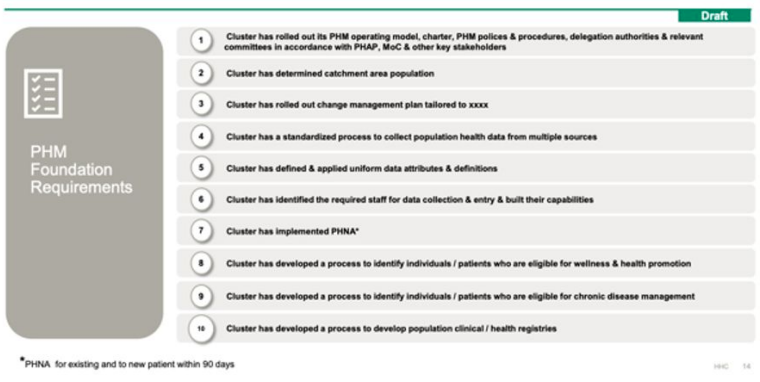
The end goal of PHM is to improve the health outcomes of the patient group by monitoring and identifying individual patients within that group, and providing a comprehensive risk-specific patient-cantered care-pathways that encompass the entire health spectrum. ACO Gate 2 PHM requirements:
What are the Components of PHM?
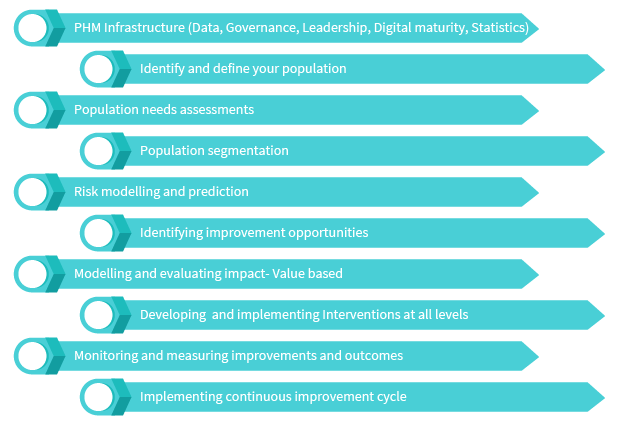
Rigorous and comprehensive Data Collection and Analysis Underpins all the components of PHM
Aligning PHM to MOC and other Cluster initiatives
- Design and deliver a Whole Population based approach at a cluster level (treating cluster as an ACO unit)
- Develop Standardised methodology for all clusters to use, so it enables them to pass the ACO gate criteria for PHM
- MOC is the delivery side while the PHM is the planning, prioritisation and direction setting function
- PHM provide the framework to evaluate the efficiency and efficacy of the MOC delivery
- PHM coexists with MOC and informs the MOC interventions
- PHM focuses on Health of the population…and sets the agenda, planning and directions for MOC delivery
- Focuses on Prevention through tools and techniques through data driven models
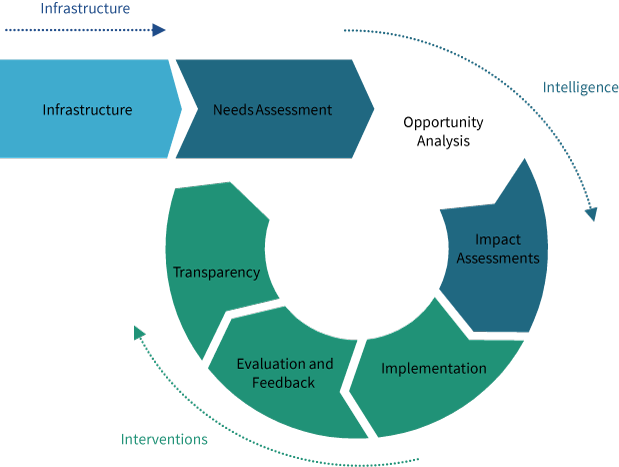
The Four Stage of Implementing PHM
We have designed Four stages for this PHM Implementation Journey and described each stage with steps and sub-steps. The Four Key Stages are:

- Step 1 Leadership
- Step 2 Population Definitions
- Step 3 Information Governance
- Step 4 Digital Maturity and Requirements
- Step 5 Data Infrastructure and Workarounds
- Step 6 PHM team structure- Capacity and Capability
- Step 7 Practical points / Lessons learnt

- Step 1 Understanding Population Need
- Step 2 Opportunity Analysis
- Step 3 Tools to target those in need
- Step 4 Impact Assessments
- Step 5 Practical points / Lessons learnt

- Step 1 Implementation of effective interventions
- Step 2 Workforce
- Step 3 Patient Empowerment and Activation
- Step 4 Care Integration- Model of care delivery
- Step 5 Practical points / Lessons learnt

- Step 1 Understanding Population Need
- Step 2 Opportunity Analysis
- Step 3 Tools to target those in need
- Step 4 Impact Assessments
- Step 5 Practical points / Lessons learnt
Stage 1- Setting up the PHM Infrastructure
- Set up a leadership team and governance representative of all parts of the system and capable of making decisions for the wellbeing of the population
- Have clearly defined, common population definitions across the system for each the geographical levels (system, place and neighbourhood)
- Make sure there is clear Information Governance (IG) set up across the system with a single accountable officer
- Be clear about the data sets that are available across the system and how they can be used
Stage 2- Developing the PHM Intelligence
- Understand the specific needs of the local population, the impact of wider determinants and to explore gaps in care and unwarranted variation, through e.g. segmentation
- Identify high and emerging risk groups most amenable to interventions and target them through tools such as risk stratification and impact-ability models
- Size the opportunity and conduct system modelling to understand impact on financial risks and incentives
Stage 3- Implementing the Interventions
- Design care models and interventions based on evidence to target priority patient groups and implementation plans, making a clear and compelling case for change with contributing resources agreed at all tiers
- Define key indicators and outcomes to be measured and evaluated for success
- Map and model workforce changes to determine gaps and new role definitions
- Implement interventions and care models
Stage 4- Continuous improvement process
- Implement a continuous PDCA cycle for PHM program evaluation in each cluster
- Develop a common Kingdom wide platform for information sharing and lessons learnt
- Evaluate impact against agreed indicators and outcomes, and whether any changes
are needed to be made (going back to understanding the needs of the population)

