Step 3 - Tools to target those in need
Once the needs of the population are understood and priority areas are identified, those who are in the greatest level of need aligned to these areas can be targeted.
The aim of this is to identify those who can be offered preventative care which will reduce the likelihood of adverse events and improve overall population health outcomes.
There are different approaches that can be used which fit broadly in to the following categories at a system level:
- Population Segmentation
- Risk Stratification
- Impactability Modelling
- Gap analysis
- Threshold models
- Clinical Experience Projections
Population Segmentation
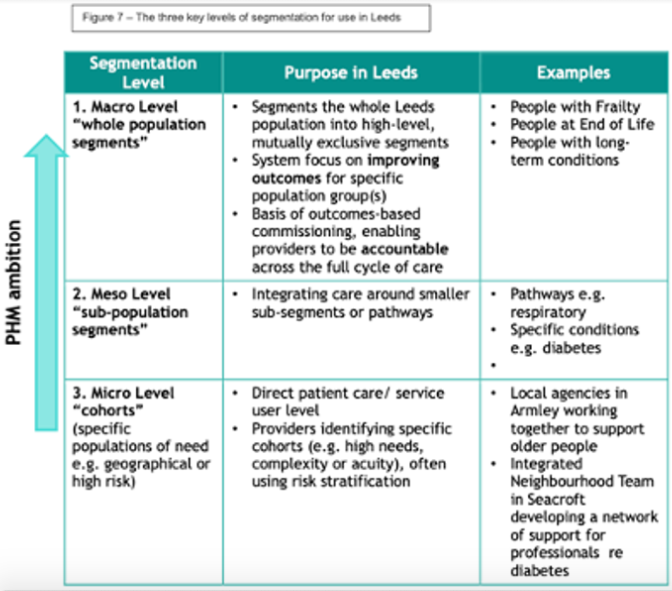
Segmentation offers the potential to deliver bespoke care to individuals while benefitting from economies of scale. It involves grouping the population in to groups based on identified criteria.
Segmentation can be performed in multiple ways, including the following:
• Clinical (e.g. people living with diabetes, frailty or multi-morbidity)
• Defined geographical area (e.g. specific community)
• Data-driven (e.g. cohorts of patients with similar patterns of health care use)
• Demographic characteristics (e.g. ethnicity, age)
• Risk based (e.g. people at very high risk of being admitted to a care home in the next 3 months)
• A combination of the above factors
Segmentation can be completed at different levels; either for the whole population or a smaller sub-group.
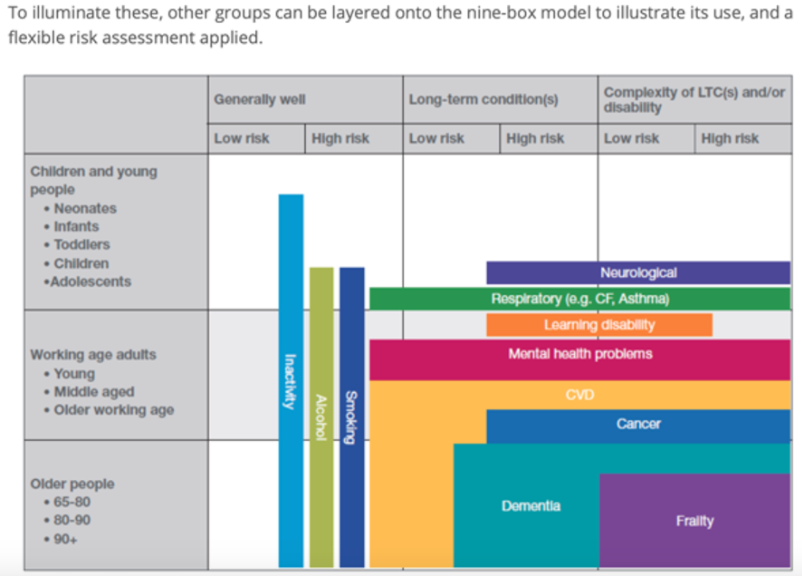
To be practical and also due to the challenges of data in KSA it is recommended that clusters start with the LTC conditions cohort first along with other segments of population contributing to the highest mortality.
The initial segments recommended for analysis and interventions are:
- Long term Conditions and chronic diseases
- Diabetes
- IHD
- Chronic kidney Disease
- Asthma/COPD
- Obesity
- Cancers- Breast, Lung, Cervix, Colorectal
- Road traffic accidents
- Pregnancy related morbidity and mortality
- Mental Disorders
- Osteoarthritis
Risk Stratification
Risk stratification constitutes one form of segmentation (i.e. the subdivision of the population into cohorts of people with similar characteristics)
Risk stratification can be used for:
- Population Intelligence
– i.e. studying de-personalised data to understand the patterns and distribution of risk across a population - Case Finding –
i.e. identifying named individuals who are at a particular level of risk, so that they can be offered a preventive intervention aimed at mitigating that risk; or
It is advised for clusters to start with Population intelligence based risk stratification first as it helps in identifying the cohorts of population at risk and what interventions can be used in large scale to impact large scale change.
Risk stratification tools predict future risk, but do not directly predict where the greatest improvement opportunities lie. Therefore an additional step to identify those individuals who are amenable to interventions is required. ‘Impactability modelling’, aims to predict which individuals identified by risk stratification will have their risk successfully mitigated by the intended preventive intervention.
Attach template for Population risk stratification
Insert link for Web based Risk stratification tool
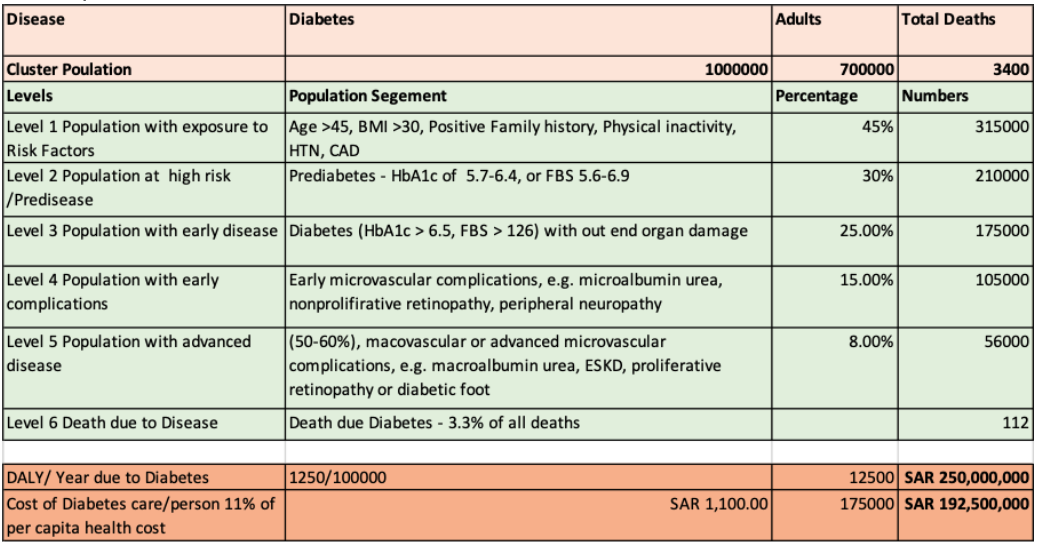
Example Risk Stratification for Diabetes in sample cluster with 1 million population
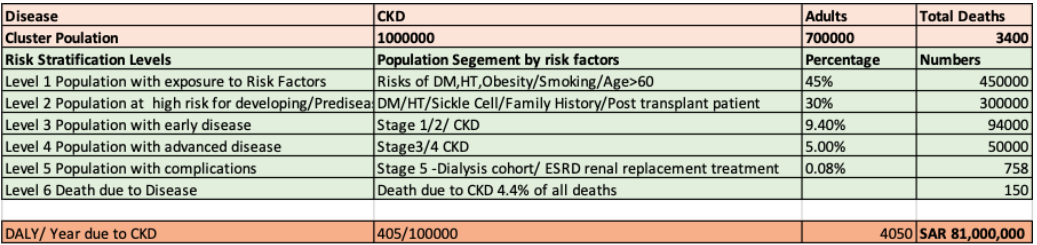
Example Risk Stratification for CKD in sample cluster with 1 million population
Practical points and lessons learnt from Risk stratification in other programs:
- Under half of those identified as high risk now (top 1%) will have an admission in the following 12 months. This accounts for a small proportion of admissions overall
- By focussing on the top 1% risk strata only 0.4% of admissions in the following year were actually prevented
- To prevent a greater proportion of future admissions, a larger risk strata could be used. However, this would involve trade-offs. Targeting a larger population with lower risk necessitates the use of lower cost interventions
- There are other challenges with regards to data timeliness, meaning adverse events can have happened before changes can be made.
- Clinical Ownership is key to success
- Fit with the system: use existing tools & referral services. Often Developing a model based on interventions possible to deliver is better than developing a full needs based model with no available interventions or budget to deliver the interventions
- Think about impactability
- Consider outcomes beyond emergency admissions. Offer suite of tailored proactive care approaches. Look beyond the highest risk users
- Many of the preventive interventions offered in risk stratification programmes appear to increase total costs rather than reduce them. Given the lack of robust evidence to support many of the hospital-avoidance interventions being offered to high-risk patients, there is a pressing need for further research and evaluation.
- The predictive accuracy of many risk stratification tools is modest. No risk stratification tool is ever completely accurate; therefore it is important to consider the potential adverse impact of false positive and false negative results as well as the benefits of true positive and true negative results.

